On Day 11 of our cruise, we were up around 5:40 a.m., knowing we’d need an early start to get a good spot before the ship reached the first set of locks. And before I go any further, a quick note, This is a long post that took quite a awhile to put together with a ton of photos and even then, none of them truly capture the scale, history, or feeling of traveling through the Panama Canal. Still, I tried to document the day as best I could.

We learned that all the ships have to wait their turn, depending on what priority they receive based on how much they pay. Of course, a cruise ship the cruise line is paying top dollar so that we can go straight through with no wait. And its hundreds of thousands of dollars…

From our balcony we could see part of the deck that juts out, and it was already packed with people…not a great sign. We grabbed our stuff and hustled up there. Sure enough, the crowd had beaten us to it, and folks had even dragged chairs up to that section. But honestly, it worked out, because it gave everyone a clear view.
Panamá City, Panama

We had a guide from the Panama Canal Authority on board with us all day, narrating each step of the transit as we moved from lock to lock.

Bridge of the Americas


The views were just so picturesque in places.


Here is us going under the bridge. Someone from the Norwegian Dawn took this photo of us and shared it on a Facebook group, which I thought was super cool!

The Norwegian Joy was transiting the Panama Canal the same day we were, but it had to peel off for the new locks since it’s too large for the historic ones. Our ship fit through the old locks, which turned out to be the far more fascinating process to watch. This photo is from the Gulf of Panama, just before we split: the Joy headed left (west) toward the new locks, and we continued right (east) into the old ones.

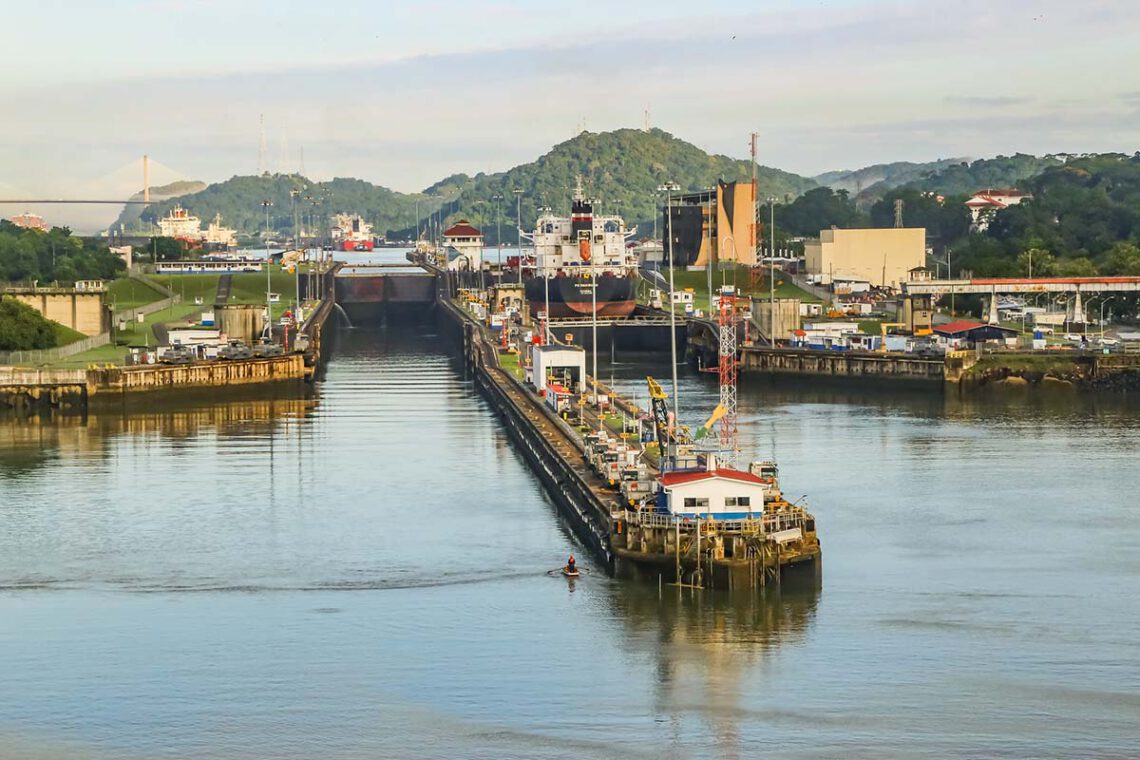
Miraflores Locks

Here you can see a big reason why many people this the older locks are my interesting to watch. The older technology in these locks uses electric locomotives (aka mules) to help keep the ship in line the ships up on both sides. Below is a photo of 4 mules on one side waiting to hook up to our ship to guide us through. They do not pull the ship through. They make sure the ship doesn’t bump the sides.

Here is a close up of the guys riding on the mules as they guided us through from our balcony.

In the pics below, you can see the PS Hamburg inside the lock and rising. So before the ship moves into a long concrete chamber. The gates behind the ship closes. In the old locks, the mules keep the ship centered so it doesn’t scrape the walls.
From inside the locks, huge valves open at the bottom of the chamber. Water from the higher level (Miraflores Lake) flows in by gravity. The chamber fills and ship rises smoothly with the water. Think of it like pulling into a bathtub and closing the drain.

We watched as our ship entered the first set of locks and began to rise. The sun was beating on the back of my neck, and out of nowhere I started to feel nauseous, so we slipped away. I barely made it to a bathroom in time and did end up getting sick. Thankfully we left when we did. Afterward, I pressed a cool paper towel to my neck, and that really helped settled me.
After that we went to our room and watched from our balcony for a bit.

This is at the end of the Miraflores Locks, where the mules are turning around to go back to the other side for the next ship.

The black, white, and red ship in the distance that looks like its on land is in the new locks as we sail in Miraflores Lake.

Pedro Miguel Lock
We moved to the back of the ship for the next set of locks, and it turned out to be the perfect spot. From the stern, you can watch the gates close behind us and see the whole chamber settle around the ship.
Here, the ship is going down inside the locks. The valves open and let water flow out to the lower level. The chamber drains, and the ship sinks gently with the water. No pumps. No engines. Just gravity and the same clever plumbing from 1914 still doing its job beautifully.

Centennial Bridge
The Centennial Bridge rises over the freshwater of the Culebra Cut, the narrow, carved-through-the-mountains section of the Panama Canal. By the time ships pass beneath it, they’ve already left the Pacific’s saltwater behind and been lifted into the canal’s inland freshwater system. The bridge spans one of the most dramatic stretches of the transit with steep hills, layered rock, and the tightest channel of the entire canal.

Culebra Cut
After leaving the Pedro Miguel Lock, you immediately enter the Culebra Cut, the narrow, carved-through-the-mountains section. At the north end of the Cut, the Chagres River flows into the canal near Gamboa. From there, the waterway opens into the vast Gatún Lake, which carries you all the way to the Gatún Locks.

The terraced hillside in this stretch of the Panama Canal is part of the historic Culebra Cut, where engineers carved through the Continental Divide and battled constant landslides. These steep, stepped slopes are the result of decades of excavation and stabilization work, especially after the massive slides that once buried equipment and reshaped the channel. Today, the green buoys and calm water make it look peaceful, but this was one of the most challenging and hard fought sections of the entire canal.

Gold Hill
Gold Hill was one of the most challenging obstacles in building the Panama Canal, with unstable rock, heavy rains, and constant landslides repeatedly collapsing the excavation and reshaping the Culebra Cut. The worst slides of 1912–1913 came from Gold Hill and neighboring Contractor’s Hill, burying equipment and dumping millions of cubic yards of debris into the channel. Ultimately, engineers stabilized the ridge through terracing, drainage systems, and relentless excavation—an effort that became one of the defining achievements of the U.S. construction era.
Unfortunately, this is the only shot I got of Gold Hill because we were inside getting something to eat.

Chagres River

Gatún Lake This is from Gatún Lake as we get closer to the last set of locks; Gatún Locks.

Since both the old and new locks feed into the same lakes, we eventually met up with the Norwegian Joy again.

Gatún Locks
Gatún Locks handle the full 85‑foot descent on the Atlantic side, lowering ships from the quiet green sweep of Gatún Lake back toward sea level. Even after more than a century, the old chambers move with that same steady confidence, carrying vessels from the calm heart of the canal toward the bustle of Colón and the open Caribbean.
Here we are in Gatún Locks with another ship next to us going through.

9°16’26.9″N 79°55’22.7″W
Some guys on that ship

A different perspective on the mules, the locomotives that guide us steadily through the lock walls.

Right beside the locks sits the Gatún Lighthouse, a range light that helps ships line up perfectly as they enter or exit the chambers. It’s part of the canal’s original navigation system, guiding vessels onto the correct heading as they leave the locks and move into the long straight stretches of Gatún Lake or the Atlantic approach.

I love this shot. It captures just how narrow these locks feel, like threading a needle with a ship.

This shot really shows how far the ship has to rise inside the lock—an entire story of water lifting up to the next level.

Atlantic Bridge

After we slipped under the Atlantic Bridge, I looked back to catch this angle.

As we sailed out of the old Gatún Locks and left the Panama Canal behind, the Caribbean opened up in front of us, as Colón’s skyline rising under a sweep of dramatic clouds and ships anchored across the bay. After a morning threaded through chambers and cables, this wide, quiet harbor felt like an exhale, the last glimpse of the canal before we sailed back into open water.

In 2025 the Panama Canal generated a record $5.7 billion in revenue and posted a net profit of $4.1 billion—an increase of $695 million over the previous year. More than 13,000 ships crossed the isthmus, including over 225 cruise ships making the full transit. It’s a reminder of just how busy and essential this 51‑mile shortcut remains to the world.

Although we never left the ship that, with the heat and the moving around to get the best views, we were zonked! However, we ready for a nice meal, so we rested up, got showers, and headed to dinner to see what our dinner mates thought of the day. The night culminated with the Broadway type show “Dear Future Husband.”
What an epic day!